
When the Government Pulls an AI Off the Shelf
What the Fable & Mythos shutdown means for you - in plain language
-A client briefing from Ethos AI Consultants · June 13, 2026
If you caught the headlines this week about the U.S. government ordering Anthropic to switch off two of its most powerful AI models, here’s what it actually means - without the jargon, and with the part that matters for your business.
What happened, plainly
On June 12, the government ordered Anthropic to immediately disable two AI models, Mythos 5 and Fable 5, citing national security. These were its most capable models, especially good at finding weaknesses in software. The trigger was a reported “jailbreak” - a trick that gets an AI to slip past its own safety rules. Anthropic says the flaw was minor and that other AI tools can already do much the same thing; the government hasn’t yet shared its full reasoning publicly. Other AI tools were not affected. But for the first time, a government has forced a public AI model offline, and that precedent is the real story.
Why it matters to you
No AI tool is permanent. A service millions of people relied on disappeared overnight by order. The technology you build on can change without warning - so it’s worth not leaning your whole operation on any single tool.
This is a moment for steady judgment, not panic. The facts are still emerging and thoughtful experts disagree. Good decisions here come from people weighing the evidence - not from reacting to headlines.
What we’d suggest you do
Don’t depend on a single AI. Keep a backup tool approved and ready, so one outage can’t stop your work.
Know what you’re running. Keep a simple list of which AI tools your team uses, and for what.
Read the fine print. Understand each tool’s data-retention and service-continuity terms before you rely on it.
Keep a human in the loop. Let AI assist your decisions, not make them unattended - especially for anything sensitive.
Stay informed, stay calm. Follow the story from a few trusted sources. We’ll keep you posted as it develops.
At Ethos, we believe AI should serve people - used responsibly, with humans firmly in charge. Moments like this are exactly why we help you adopt AI in a way that’s resilient, transparent, and built to last - so a surprise like this is a headline you read, not a crisis you weather.
Ethos AI Consultants · Prepared June 2026 · General guidance on a developing story; not legal advice.
Sources
Primary source and news coverage use for this briefing. Because this is a developing story, details and URLs may be updated after publication. These were the sources at the time this post was written.
Primary source
Anthropic. (2026, June 12). Statement on the US government directive to suspend access to Fable 5 and Mythos 5.https://www.anthropic.com/news/fable-mythos-access
News coverage
Loizos, C. (2026, June 12). Anthropic’s safety warnings may have just backfired — the government has pulled the plug on its most powerful AI. TechCrunch. https://techcrunch.com/2026/06/12/anthropics-safety-warnings-may-have-just-backfired-the-government-has-pulled-the-plug-on-its-most-powerful-ai/
CNBC. (2026, June 12). Anthropic disables access to Fable 5 and Mythos 5 to comply with government directive.https://www.cnbc.com/2026/06/12/anthropic-disables-access-to-fable-5-and-mythos-5-to-comply-with-government-directive.html
Fortune. (2026, June 13). Anthropic disables Fable and Mythos AI models after U.S. government bars it from giving foreigners access.https://fortune.com/2026/06/13/anthropic-disables-fable-mythos-export-controls-national-security-threat/
NBC News. (2026, June). Anthropic suspends new AI models after government directive.https://www.nbcnews.com/tech/tech-news/anthropic-suspends-new-ai-models-fable-mythos-government-directive-rcna349901
TheNextWeb. (2026, June). US government orders Anthropic to kill Fable 5 and Mythos 5 in unprecedented AI model recall.https://thenextweb.com/news/anthropic-fable-mythos-us-government-suspension
Market reaction
CoinDesk. (2026, June 13). Anthropic’s pre-IPO shares fall as US government shuts down its most powerful AI model.https://www.coindesk.com/markets/2026/06/13/anthropic-s-pre-ipo-shares-fall-as-us-government-shuts-down-its-most-powerful-ai-model
The "Shadow AI Economy": Your Employees’ Secret Superpower
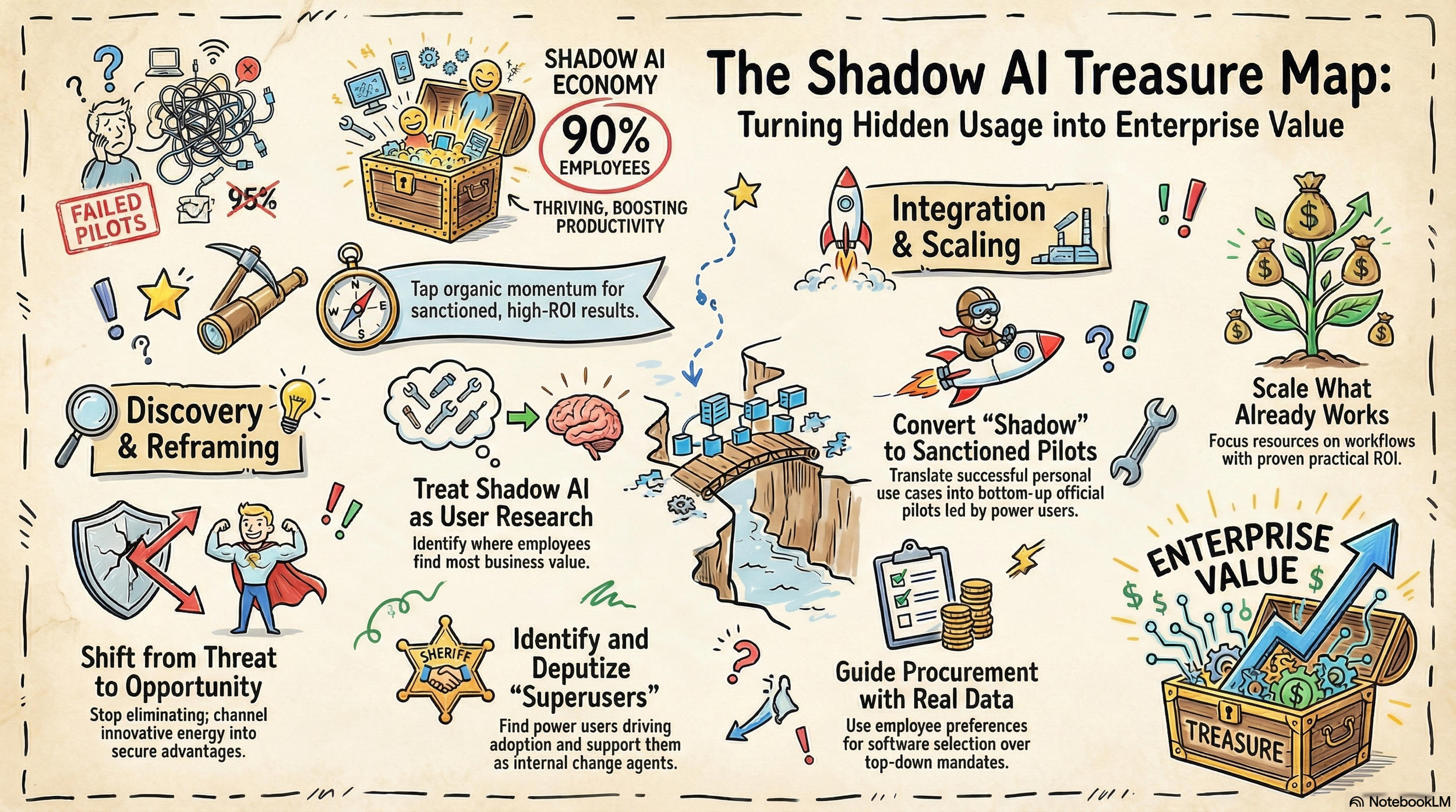
While many companies are still stuck in the "pilot phase" of official AI rollouts, a vibrant Shadow AI Economy is already thriving under the radar. Recent data shows that at 90% of companies, employees are regularly using personal AI tools like ChatGPT to get their work done—often without telling IT. It’s a classic case of the "secret advantage"; people are finding that these tools make them faster and more creative, even if they have to pay for the subscriptions out of their own pockets. Instead of viewing this as a security headache to be shut down, smart leaders are starting to see it for what it really is: the ultimate form of unfiltered user research.
If your team is "ghosting" your official systems in favor of their own AI workarounds, they aren’t trying to be rebellious—they’re trying to be productive. This clandestine adoption is a clear signal of exactly where the friction exists in your daily operations. By shifting your perspective from "policing" to "partnering," you can turn this underground energy into a massive enterprise-wide asset. Here is how you can stop fighting the shadow economy and start harnessing it for your company’s benefit:
How to Harness the Shadow AI Economy
Listen to the "Whispers": Use the current unauthorized usage as a treasure map. Identify which departments are using AI most heavily and ask them what specific problems the tools are solving that your internal systems aren't.
Empower Your "Superusers": Find the employees already thriving in the shadow economy and deputize them as change agents. Let them help co-design your official AI strategy rather than imposing a top-down mandate they’ll likely ignore.
Bridge the "Learning Gap": Move away from rigid, "one-size-fits-all" enterprise tools. Invest in agentic AI systems that are flexible and can actually adapt to the real-world, messy workflows your employees deal with every day.
Capture Proprietary "Process Data": The real "moat" for your business isn't the AI model itself—it’s the unique data generated by your employees as they interact with these tools. Create a safe, sanctioned environment in which this "how-to" knowledge is captured and used to fine-tune your company's AI.
Implement a "Safe-to-Fail" Sandbox: Instead of a total ban, provide a secure, company-approved playground where employees can experiment with various models without risking sensitive data. This keeps the innovation internal and secure while maintaining the speed they crave.
Sources:
Belcak, P., et al. (2025). Small Language Models are the Future of Agentic AI. arXiv preprint arXiv:2506.02153.
Estrada, S. (2025, August 19). The 'shadow AI economy' is booming: Workers at 90% of companies say they use chatbots, but most of them are hiding it from IT. Fortune.
MIT NANDA Initiative. (2025). The GenAI Divide: State of AI in Business 2025. MIT Sloan School of Management.
Teki, S. (2025, August 21). The GenAI Divide: Why 95% of AI Investments Fail?. Sundeep Teki - AI Strategy & Insights.
Why Your AI Strategy Needs a Human Soul
In our last post, we looked at how AI has been the "invisible engine" under the hood of our daily lives for years. But as we move from passive users to active creators with generative AI, a new anxiety has emerged: If I use AI to do my work, is it still mine?
The secret to reclaiming your time without losing your professional soul is a framework called Human-in-the-Loop (HITL). Think of AI not as a replacement for your brain but as a high-speed intern.
The Three Pillars of Successful Collaboration
To get the most out of AI while maintaining your high standards, you need to master these three phases of the "Loop":
1. The Spark (Intentional Prompting)
An intern only performs as well as the instructions they receive. If you ask an AI for "a blog post about leadership," you’ll get a generic, lukewarm response.
The Ethos Way: Provide the "Spark." Tell the AI your specific perspective, the audience you're speaking to, and the "why" behind the message. When you provide the unique intent, the output carries your DNA from the very first word.
2. The Heavy Lifting (AI Generation)
This is where the magic of "reclaiming time" actually happens. Once you’ve provided the Spark, let the AI handle the grueling "blank page" phase. It can crunch data, summarize long meetings, or generate a rough first draft in seconds. It does the 80% of the work that usually drains your energy, leaving you fresh for the most important part.
3. The Filter (Critical Review)
This is the non-negotiable step. AI is brilliant, but it lacks empathy, ethics, and—occasionally—accuracy.
The Human Touch: This is where you apply the "Filter." You check the facts, inject your personal anecdotes, and smooth out the "AI" phrasing. By the time you’re done, the AI’s contribution is the foundation, but the finishing architecture is entirely yours.
Reclaiming Your Creative Agency
Using AI doesn’t make you less of an expert; it makes you a more efficient one. By offloading the mundane "heavy lifting" to a digital assistant, you free up your cognitive bandwidth for high-level strategy and genuine human connection—the things no algorithm can replicate.
The future of work isn't "Human vs. AI." It's Human + AI.
What aspects of your work feel like "heavy lifting"? I’d love to help you design the custom AI assistance you need. Book a discovery call and let's start reclaiming your schedule today.

AI in Everyday Life
AI in Every Day Life
You might be surprised how much AI has already been a part of your life for a decade or two now. With the rise of generative AI, which is the type that generates new text, audio, video, or photo, there’s a lot of hype out there. But what people don’t know is that AI has been the invisible engine under the hood of most modern conveniences for a couple of decades now. Here are 10 ways AI has existed in daily life that you may not be aware of and, in some cases, wouldn’t want to live without!
Map Software: Apps like Google Maps or Apple Maps don’t just show a static image; they use AI to analyze real-time data from millions of users to predict traffic jams and suggest the fastest route before you even put the car in gear.
Autocorrect: Beyond just fixing typos, modern autocorrect uses natural language processing (NLP) to learn your personal slang, contact names, and typing patterns to predict the next word you’re likely to use.
Credit Scoring: Banks use machine learning algorithms to assess risk by processing thousands of data points—far beyond just your payment history—to determine your creditworthiness in a matter of seconds.
Weather Forecasting: Modern meteorology relies on massive AI models that simulate atmospheric conditions and compare them against historical patterns to provide the hyper-local, "rain starting in 5 minutes" alerts we rely on.
Email Spam Filters: Long before ChatGPT, your inbox was using machine learning to analyze headers and content to filter out "Prince" scams and junk mail. If you use Gmail, you are probably reliant on the way it can separate promotional, updates, social, and main inboxes as well as the spam.
Personalize Shopping & Streaming: Whether it's "Recommended for You" on Amazon or your Netflix "Top Picks," or Spotify “Smart Shuffle” AI is analyzing your past behavior to predict what you’ll want next.
Rideshare Pricing & Matching: Uber and Lyft use AI to predict demand in certain neighborhoods and set "surge" pricing, while also calculating the most efficient route for drivers.
Facial Recognition: Every time you glance at your phone to unlock it with FaceID, you're using a neural network, which is just a fancy type of AI model, that identifies your unique facial geometry.
Social Media Feeds: Your Instagram or LinkedIn feed isn't chronological; an algorithm (AI) decides which posts you’re most likely to engage with to keep you scrolling.
Smart Home Thermostats: Devices like Nest learn your daily schedule and temperature preferences to optimize energy use without you having to touch a dial.
It is easy to view AI as a futuristic concept, but as these examples show, it has been the quiet architect of our daily efficiency for years. These tools don't just provide convenience; they represent a fundamental shift in how we manage our most precious resource: time. By automating the mundane, like filtering spam or calculating traffic, AI allows us to focus on the work that truly matters. As we move from using AI "by default" to using it with intention, the opportunity to reclaim our schedules and redefine success becomes even greater.
What’s one "invisible" AI tool you can’t live without? I’d love to hear how you’re already using technology to simplify your day. Drop a comment below or share this post with a friend who thinks they "don't use AI!"